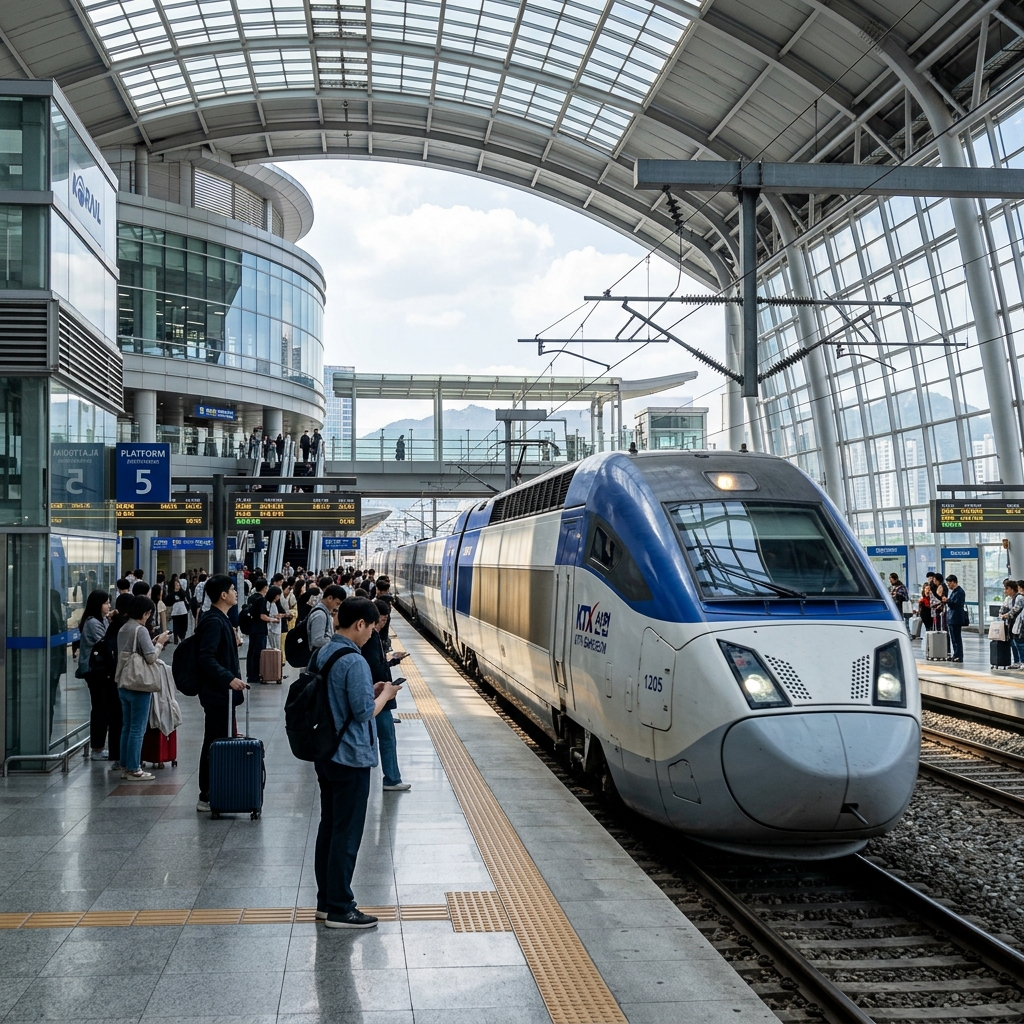
A Factual Guide to Booking KTX Train Tickets in South Korea
The Korea Train eXpress (KTX) is the backbone of South Korea’s transportation network, connecting Seoul to the country’s major cities with remarkable speed and efficiency. For travelers, it is the most practical method for journeys between destinations like Busan, Gyeongju, and Jeonju. However, navigating the booking process, particularly for non-residents, involves specific challenges and choices that can significantly impact cost and convenience. This guide provides an objective, detailed breakdown of the booking systems, common pitfalls, and essential boarding procedures.
Official vs. Third-Party Booking Channels
Travelers have two primary avenues for securing KTX tickets: the official operator, Korail, or various international third-party travel agencies. Each channel presents distinct advantages and disadvantages related to cost, user experience, and payment reliability.
Korail (Official Operator)
Booking directly through Korail is the most straightforward method in theory. The official English-language website is “Let’s Korail,” and there is a corresponding mobile app, “KorailTalk.”
- Pros: Direct access to the entire inventory of seats and schedules without any markup. This is the only source for certain promotional fares and the official channel for purchasing the Korail Pass, a rail pass for foreign visitors. Seat selection is available, allowing passengers to choose window or aisle seats, as well as forward-facing or reverse-facing seats.
- Cons: The primary drawback is the payment system’s notorious difficulty with foreign-issued credit cards. The system relies on 3D Secure authentication protocols that frequently fail or time out, especially during peak booking hours (e.g., 7:00-9:00 AM KST). Error messages are often unhelpful, leading to significant user frustration. The website interface, while functional, is less intuitive than modern travel platforms. The KorailTalk app offers a better mobile experience but often requires a Korean phone number for full functionality, a barrier for most tourists who may be better served by a dedicated Incheon Airport SIM Card & eSIM Guide to secure local connectivity upon arrival.
Third-Party Resellers (e.g., Klook, Trip.com)
A growing number of international travel platforms act as official resellers for Korail tickets. These services are designed specifically for foreign tourists.
- Pros: The most significant advantage is a smooth, reliable payment process that readily accepts international credit cards and other payment methods like PayPal. User interfaces are typically modern, multilingual, and far more intuitive. Customer support is often more accessible and better equipped to handle inquiries from foreign travelers.
- Cons: Convenience comes at a cost. These platforms almost always include a service fee or a slight markup on the ticket price. More critically, seat selection is usually not an option; seats are automatically assigned by the system. Ticket confirmation may not be instantaneous. The reseller books the ticket on your behalf, and you receive a voucher first, with the final e-ticket delivered via email later. This can be problematic for last-minute bookings. Furthermore, they may not offer the full range of train times or fare types available on the official Korail site.
Step-by-Step Booking Guide & Platform Comparison
The booking process differs fundamentally between the official channel and third-party resellers. Understanding these differences is key to a successful transaction.
| Feature | Korail (Official Website) | Third-Party Resellers |
|---|---|---|
| Price | Base fare, no markups. | Base fare plus a service fee or markup (typically 5-10%). |
| Payment Success (Foreign Cards) | Low to moderate. Frequent failures with 3D Secure authentication. | High. Optimized for international payment systems. |
| Seat Selection | Yes. Full control over seat choice (window/aisle, forward/reverse). | No. Seats are typically assigned automatically. |
| Instant Confirmation | Yes. Ticket is issued immediately upon successful payment. | No. A voucher is issued first; the official ticket may follow hours later. |
| User Interface | Dated and can be confusing to navigate. | Modern, streamlined, and user-friendly. |
| Korail Pass Booking | Yes, this is the official channel. | Yes, most major resellers also offer the Korail Pass. |
Booking via the Official Let’s Korail Website
- Navigate and Select Route: Go to the English version of the Let’s Korail website. Use the booking widget to select your departure and arrival stations (e.g., Seoul, Busan), travel date, and number of passengers.
- Choose Train and Fare: The next screen displays all available trains for that day. Select your preferred departure time. Note the train type (KTX, KTX-Sancheon).
- Enter Passenger Information: Enter your details. It is critical that your name matches your passport exactly. Select your nationality and enter your passport number. Create a password for managing your booking later.
- Seat Selection: You will be shown a seat map of the train car. A key detail is that many KTX seats are fixed; half face forward and half face backward for the direction of travel. The map indicates direction with arrows. Select your preferred seats.
- Payment: This is the most common point of failure. On the payment screen, select “Foreign Card.” You will be redirected to a payment gateway. Be prepared for potential issues with your bank’s security verification. Having a comprehensive Korea Travel Money Guide can help you prepare alternative payment strategies. If the payment fails, try a different card or attempt the booking during non-peak hours (e.g., late at night KST).
- Confirmation: Upon successful payment, you will receive a confirmation. It is essential to print this e-ticket or save a high-quality PDF/screenshot to your phone. Do not rely solely on being able to access it online later.
⚠️ Critical Booking Mistakes & Traveler Notes
- Holiday Travel (Seollal & Chuseok): Booking KTX tickets for Korea’s two largest holidays, Lunar New Year (Seollal) and Korean Thanksgiving (Chuseok), is extremely competitive. Tickets go on sale on a specific date about a month in advance and sell out within minutes. The Korail servers are often overwhelmed. Non-essential travel during these multi-day periods is strongly discouraged for tourists.
- Forward vs. Reverse-Facing Seats: Many travelers are sensitive to sitting in a seat that faces opposite the direction of travel. Only the official Korail website guarantees the ability to select a forward-facing seat. If booking through a third party, you accept the risk of being assigned a reverse-facing seat.
- Passport Name Mismatch: Conductors perform random checks, and if the name on the ticket does not exactly match the name on your passport, your ticket could be invalidated. Double-check all passenger details before confirming payment.
- Korail Membership: The Korail membership program (코레일멤버십) offers discounts and rewards but is not accessible to short-term tourists, as it requires a Korean Alien Registration Card (ARC) or resident number for registration.
- Digital Preparedness: While a screenshot of your ticket is usually sufficient, having a reliable internet connection is vital for managing bookings or accessing other travel necessities. Ensure you have one of the 5 Must-Have Apps for Korea Travel downloaded and ready before your trip.
At the Station & Boarding the KTX
Korean train stations are modern and efficient, but can be overwhelming for first-time visitors. A methodical approach ensures a smooth departure.
Navigating the Station
Major hubs like Seoul Station, Yongsan Station (Seoul), and Busan Station are large complexes with multiple levels. Plan to arrive at least 20-30 minutes before your scheduled departure time. Locate the large digital departure boards (전광판, jeongwangpan). These boards display the train number, final destination, platform number (타는 곳, taneun got), and departure time. Your platform will typically be announced 15-20 minutes before departure.
Platforms and Boarding
A unique feature of the Korean rail system is the lack of ticket barriers or turnstiles to access the platforms. Passengers can walk directly to their platform. This is an honor-based system, but do not mistake it for a lack of enforcement. Conductors patrol every train and use a digital seating chart to verify that each seat is occupied by a ticketed passenger. They will ask to see the tickets of anyone in an unassigned seat.
Your ticket will specify your car number (호차, hocha) and seat number (좌석, jwaseok). The platforms have signs indicating where each car number will stop, allowing you to wait in the correct position for efficient boarding.
Onboard Experience and Amenities
- Luggage: Each car has overhead racks suitable for backpacks and small carry-on luggage. For larger suitcases, there are dedicated luggage storage areas at the front and rear of each car. These spaces are limited and fill up quickly on popular routes, so board promptly if you have large bags.
- Amenities: KTX trains are equipped with free Wi-Fi, though it can be slow and may require navigating a Korean-language portal to connect. Power outlets are available but often located only on the wall between windows, not at every seat. Clean restrooms and vending machines are located between cars.
- First Class vs. Economy Class: First Class tickets cost approximately 40% more than Economy. The primary benefits are a wider seat in a 2+1 configuration (versus 2+2 in Economy), increased legroom, a complimentary bottle of water, and a small snack pack (e.g., nuts and a cookie). For short journeys of under two hours, the value proposition is poor. The upgrade is more justifiable for the nearly three-hour trip from Seoul to Busan, where the extra space can significantly improve comfort.
Upon arrival at your destination, you simply disembark and exit the station. For onward travel, services like local taxis or ride-hailing are readily available. Understanding How to Use Kakao T in Korea is highly recommended for seamlessly booking a taxi from the station to your final destination.
Written by Min-Woo Park (Senior Travel Editor)
Min-Woo Park is a Senior Travel Editor for K-Travel Insider, specializing in South Korean public transportation systems, digital payment logistics, and foreigner travel guides. He covers official Korail regulations, transit passes, and local payment technologies.
Home |
About Us |
Contact Us |
Privacy Policy |
Terms of Service |
Disclaimer
Copyright © 2026 K-Travel Insider (koreanvalueinvestor.com). All rights reserved.