KOSPI Already Hit 8,000 — Here’s Why It Could Go Much Higher
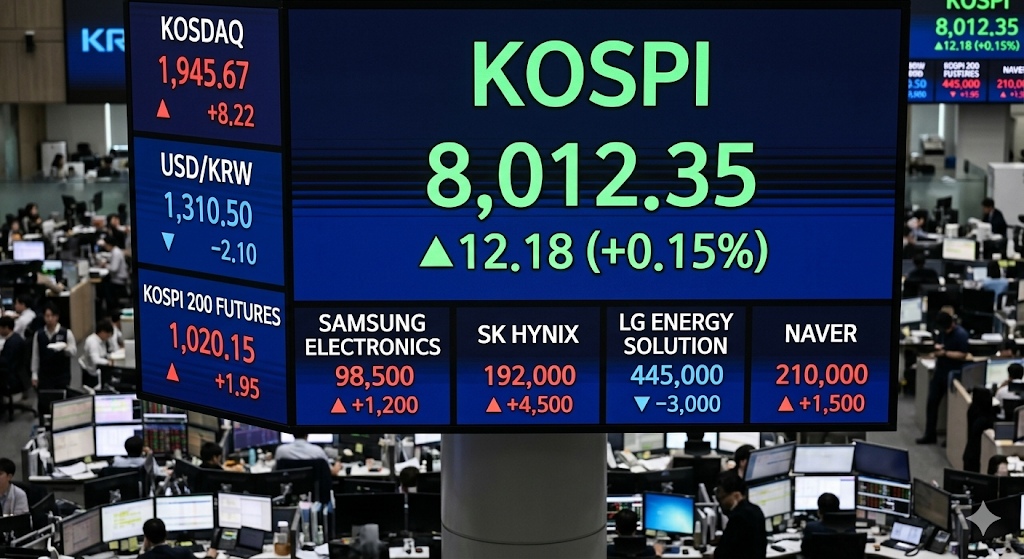
Nobody believed this was possible. The South Korean stock market started 2026 at 4,309. It crossed 5,000 in January, 6,000 in February, 7,000 on May 6th, and the KOSPI 8000 milestone was shattered just 8 trading days later. Going from 7,000 to 8,000 in eight days is not a standard market rally — that is a supernova. And yet, institutional analysts aren’t calling a top; they are raising targets for this ongoing KOSPI 8000 bull run.
The Numbers That Matter Beyond KOSPI 8000
KB Securities just raised their 2026 KOSPI target from 7,500 to 10,500 — a 40% upward revision in a single move. Yuanta Securities has a second-half band of 7,600 to 10,000. Some aggressive scenarios point to 12,000. These aren’t retail speculators. These are institutional analysts with complex models behind them. So what do they see in the post-KOSPI 8000 landscape?
Reason #1: Korea Is Now an AI Supply Country Driving KOSPI 8000
This is the insight most global investors are missing. Everyone understands that AI is driving demand for semiconductors. What fewer people understand is Korea’s unique position in the global supply chain, which is the primary catalyst for KOSPI 8000.
Korea isn’t an AI user country — it’s an AI supplier country. As global data center buildout accelerates, the bottleneck has shifted from compute to memory, power equipment, and storage. Korea dominates all three.
Samsung Electronics and SK Hynix’s combined operating profit is projected to surge from 91 trillion KRW in 2025 to 630 trillion KRW in 2026 — a 7x increase in a single year. That’s not a valuation story. That’s a fundamental earnings story driving the KOSPI 8000 re-rating.
Reason #2: The Financial Infrastructure Was Rebuilt for KOSPI 8000
Even great earnings don’t produce a supernova rally on their own. Money needs a wide, frictionless door to walk through. Until recently, Korea’s door was narrow and complicated. Two structural changes opened that door and paved the way for KOSPI 8000.
The Omnibus Account System and KOSPI 8000 Inflows
Previously, global asset managers like BlackRock and Vanguard faced a major obstacle entering Korea: complex pre-registration requirements and account setup procedures for every end investor. It was slow, expensive, and frustrating.
The full launch of Korea’s foreign investor omnibus account system changed this completely. Now, global institutions can aggregate orders from multiple end investors under a single account — the same standard used in the U.S., Europe, and Japan.
The result: the speed and convenience of passive fund flows into the market improved dramatically, triggering the KOSPI 8000 surge. The pipe was already there. Korea just made it wide enough for real institutional money to flow through.
WGBI Inclusion, Extended FX Hours, and KOSPI 8000 Stability
Foreign equity flows and currency are inseparable. When Korea secured inclusion in the WGBI (World Government Bond Index), tens of trillions of won in stable global bond money began flowing into Korea — stabilizing the Won and making equity investment more attractive for foreign funds simultaneously.
On top of that, Korea extended its FX market trading hours and is moving toward a 24-hour system from July 2026. For global funds operating across time zones, this removes a critical friction point, securing structural support above KOSPI 8000.
Reason #3: The MSCI Developed Market Wildcard
Korea has been classified as an “emerging market” by MSCI for over a decade — despite being the world’s 13th largest economy. That classification matters enormously for sustainability beyond KOSPI 8000. Global funds tracking the MSCI Developed Markets Index manage approximately $16.5 trillion, compared to just one-fifth of that for emerging market funds.
UBS estimates that MSCI Developed Market inclusion could trigger up to $24 billion in passive foreign inflows. Goldman Sachs estimates $30 billion. These aren’t trading flows — they’re long-term institutional allocations that don’t reverse easily, providing a massive buffer for KOSPI 8000 assets.
The Korean government has published a comprehensive reform roadmap targeting the six areas MSCI rates as insufficient. If Korea gets placed on MSCI’s watchlist in June 2026, formal inclusion could happen as early as 2027–2028. The market is already pricing in this probability.
Reason #4: Foreign Ownership Just Hit a 6-Year High
Foreign investors’ share of KOSPI market cap crossed 39% — the highest in six years. And crucially, the buying has broadened during the KOSPI 8000 rally. Early in the trend, it was purely Samsung and SK Hynix. Now it’s spreading to defense, robotics, power equipment, and financials.
KB Securities noted that the market is shifting from two-stock concentration to healthy sector rotation — a sign of a maturing bull market, not a bubble about to pop.
The KOSPI 8000 Risk Nobody Is Talking About
Here’s what concerns me as a GARP investor regarding the current KOSPI 8000 climate. After 8,000 broke, foreigners sold 20+ trillion KRW in just 8 trading days — the third-largest monthly selling on record. Most analysts are calling it profit-taking, but the speed of that selling is worth watching closely.
The market went from 7,000 to 8,000 in 8 trading days. That kind of vertical move creates its own risk — not because the fundamentals are wrong, but because price can run ahead of even the most optimistic earnings revisions.
My approach: I’m not chasing names that already ran 100%+. I’m looking at sectors that participated late in the KOSPI 8000 cycle — defense, power equipment, and select financials — where the earnings case is real but the price hasn’t fully caught up.
Conclusion: Can KOSPI Reach 10,000 After KOSPI 8000?
If the AI semiconductor supercycle continues, if MSCI inclusion proceeds, and if the infrastructure upgrades keep attracting institutional money — yes, 10,000 is achievable after consolidating at KOSPI 8000. That’s three “ifs,” not three guarantees.
What I’m more confident about: Korea’s structural re-rating from perennial discount market to legitimate global growth story is real, durable, and still early. The infrastructure that enables foreign money to flow in has been fundamentally upgraded. The direction is right. The pace is the variable.
Disclaimer: This article is for informational purposes only and does not constitute financial, investment, or legal advice. The figures and projections mentioned are based on market consensus and institutional reports at the time of writing. Investing in equities involves risks, including the loss of capital. Past performance is not indicative of future results.