How to Use WOWPASS in Korea: 2026 Foreigner’s Cashless Travel Guide
South Korea’s economy operates on a near-cashless basis, a reality that presents a significant hurdle for international visitors. While major hotels and department stores accept foreign credit cards, smaller restaurants, independent coffee shops, and ticket machines frequently reject them, leading to inconvenient and frustrating payment failures. The WOWPASS card is a financial product designed specifically to bridge this gap for tourists. It functions as an all-in-one prepaid debit card, public transit pass, and currency exchange service, streamlining financial transactions for foreigners navigating the country’s advanced payment infrastructure.
This guide provides an objective analysis of how to use WOWPASS in Korea, detailing its operational mechanics, comparing it to alternative payment methods, and highlighting critical limitations that every traveler must understand before purchasing one.
How WOWPASS Works: Issuance, Currency Exchange, and App Setup
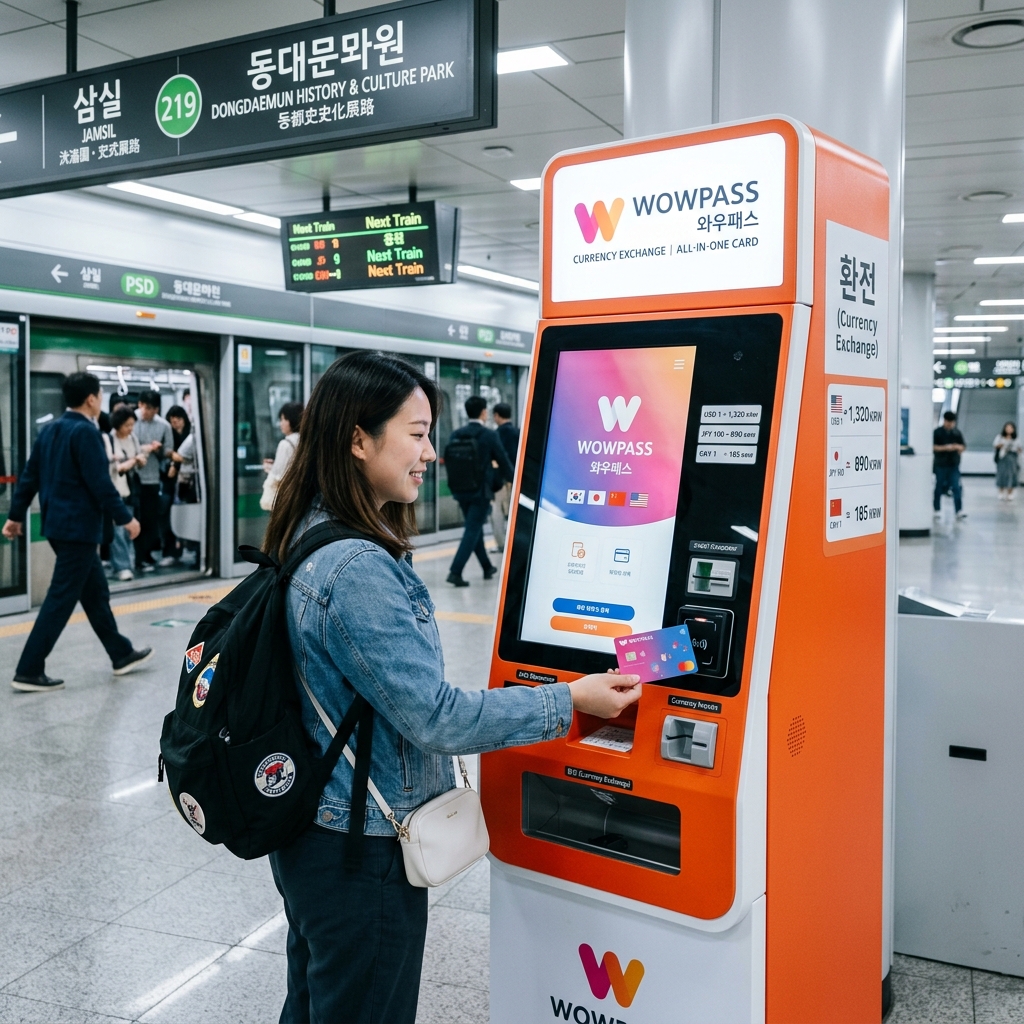
The WOWPASS system is built around a network of self-service kiosks strategically placed in international airports, major subway stations, and select hotels. The entire process, from issuance to daily use, is designed to be independent of traditional bank branches.
Card Issuance at a WOWPASS Kiosk
Acquiring a WOWPASS is a straightforward process that requires a valid passport and foreign currency cash. The automated kiosks guide users through the following steps:
- Select “Issue a new card”: The kiosk interface supports multiple languages.
- Scan Passport: The machine scans the photo page of your passport for identity verification, a standard anti-money laundering procedure in Korea.
- Pay the Issuance Fee: A one-time membership fee of 5,000 KRW is deducted from your initial load amount.
- Insert Foreign Currency: The kiosk accepts cash from 16 different currencies, including USD, JPY, EUR, HKD, and SGD. It converts this cash into Korean Won (KRW) to be loaded onto the card’s main balance.
- Receive Card and Change: The machine dispenses the activated WOWPASS card along with any change in KRW. The card is immediately ready for use for both shopping and transit.
Kiosks are widely available at Incheon International Airport (Terminals 1 & 2), Gimpo International Airport, and key subway hubs like Myeongdong, Hongik University, and Seoul Station. Before your trip, it is advisable to check the official WOWPASS website for an updated map of kiosk locations.
Currency Exchange and Loading
The core function of the WOWPASS kiosk is to act as a private, automated currency exchange. When you insert foreign currency, the machine applies a competitive exchange rate to convert it to KRW, which then becomes your card’s shopping balance. This eliminates the need to visit a separate currency exchange booth upon arrival. The maximum balance that can be held on the card is 1,000,000 KRW.
Topping up the card follows the same process: locate a kiosk, select “Top-up,” insert your WOWPASS, and add more foreign currency cash. This is a key distinction from a traditional debit card; you cannot top up the shopping balance online or with a credit card. A comprehensive Korea Travel Money Guide can provide further context on managing currency and payments during your stay.
Mobile App Integration
To effectively manage the card, downloading the WOWPASS mobile app is essential. After receiving the physical card, you can register it within the app by inserting it into a kiosk’s card reader. Once synced, the app provides several critical functions:
- Real-Time Balance Check: Instantly view your remaining KRW balance for shopping.
- Transaction History: See a detailed list of all purchases, including the merchant name, date, and amount.
- T-money Balance Inquiry: While you cannot manage the T-money balance in the app, you can check its current value by physically tapping your card to your phone’s NFC sensor.
- Kiosk Locator: An integrated map shows nearby WOWPASS machine locations for reloading.
The app is one of the 5 must-have apps for Korea travel, offering a level of transparency and control that is crucial for budgeting and tracking expenses.
WOWPASS vs. Traditional Payment Options
To determine if WOWPASS is the right choice for your travel style, it is important to compare its features against other common payment methods available to tourists in South Korea.
| Feature | WOWPASS | International Credit/Debit Card | Cash (KRW) | Standard T-money Card |
|---|---|---|---|---|
| Retail Acceptance | Excellent. Accepted anywhere cards are taken in Korea. | Inconsistent. Often rejected at smaller shops, restaurants, and unmanned kiosks. | Good, but inconvenient for larger purchases. Not accepted for many online/app payments. | Not applicable for retail purchases (transit only). |
| Public Transit Use | Yes, functions as a T-money card. | No, foreign cards cannot be used to tap-and-go on subways or buses. | Yes, for single-journey tickets (inconvenient) or reloading a T-money card. | Yes, this is its sole function. |
| Currency Exchange | Built-in at kiosks with competitive rates. | Handled by your home bank’s network, often with poor rates and fees. | Requires a separate visit to a bank or currency exchange booth. | Not applicable. |
| Fees | 5,000 KRW issuance fee. No foreign transaction fees on purchases. 1,000 KRW ATM withdrawal fee. | Typically 1-3% foreign transaction fee on every purchase. Potential ATM fees. | Fees associated with initial currency exchange or ATM withdrawal. | ~2,500 KRW for the physical card. No transaction fees. |
| Convenience | High. Combines payment, transit, and exchange. Requires finding kiosks to reload. | Low due to unreliable acceptance. High risk of payment failure. | Low. Cumbersome to carry, requires frequent ATM visits, and needed for T-money reloads. | High for transit, but requires a separate payment method for everything else. |
⚠️ Critical WOWPASS Pitfalls & Dual-Balance Warnings
While the WOWPASS offers significant convenience, its unique structure creates several potential points of failure and confusion that are poorly communicated in its marketing. Acknowledging these pitfalls is essential for a smooth travel experience.
The Confusing Dual-Balance System
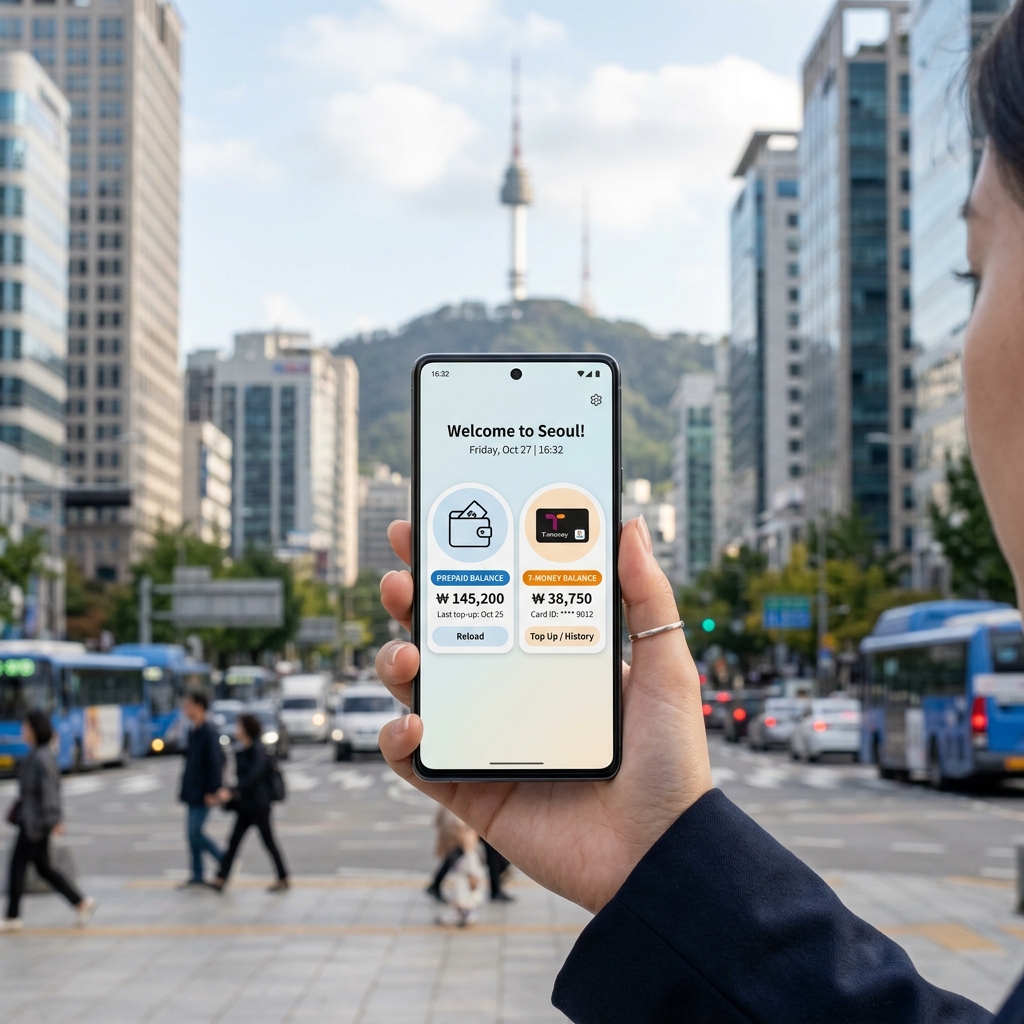
This is the single most critical point of failure for WOWPASS users. The card holds two entirely separate and non-transferable balances:
- WOWPASS Balance (for Shopping): This is the main prepaid debit card balance. It is funded exclusively by converting foreign currency cash at a WOWPASS kiosk. This balance is used for all retail purchases, from coffee shops to department stores.
- T-money Balance (for Transit): This is a separate, ring-fenced e-wallet used for tapping on subways, buses, and some taxis. This balance can only be reloaded with physical Korean Won (KRW) cash at machines inside any subway station or at convenience stores (GS25, CU, 7-Eleven).
It is impossible to transfer funds from the main shopping balance to the T-money transit balance. A traveler with 100,000 KRW on their shopping balance but 0 KRW on their T-money balance will be unable to enter a subway gate. This design flaw forces travelers to carry KRW cash specifically for transit top-ups, partially defeating the purpose of an all-in-one cashless card. Understanding how to navigate the metro is key; consult a detailed Korea Public Transit Guide to avoid issues at the turnstiles.
⚠️ Critical Dual-Balance Rule & ATM Cash Withdrawal Fee
The Golden Rule: The shopping balance (loaded with foreign cash at kiosks) and the transit balance (loaded with KRW cash at subway machines/convenience stores) are 100% separate. You cannot use one to fund the other.
Cash Withdrawal: You can withdraw your remaining KRW shopping balance from a WOWPASS kiosk’s ATM function. However, this service is not free. A non-refundable fee of 1,000 KRW is charged for each withdrawal. It is more cost-effective to spend down your balance on purchases before you depart.
Airport Kiosk Queues and Limited Locations
The convenience of acquiring a WOWPASS immediately upon arrival at Incheon Airport is a major selling point. However, during peak arrival windows (typically 10:00 AM to 2:00 PM), the queues for these kiosks can become excessively long, with wait times exceeding 30-40 minutes. This can be a significant delay, especially after a long flight. If you encounter a long line, consider waiting to get your card at a less crowded subway station kiosk in Seoul, such as at Hongik University or Myeongdong Station. This strategy works well if you have already arranged an airport transfer and have a separate Incheon Airport SIM Card & eSIM Guide to ensure connectivity upon landing.
Furthermore, the network of WOWPASS kiosks is heavily concentrated in Seoul, with limited presence in Busan and Jeju. If your itinerary is focused on smaller cities or rural provinces, the card becomes far less practical, as you will have no means to reload your shopping balance.
Reloading Requires Cash and a Kiosk
Unlike a traditional bank card, the WOWPASS shopping balance cannot be topped up digitally. Reloading requires two things: finding a physical WOWPASS kiosk and having foreign currency cash on hand. This can be inconvenient if your funds run low while you are in a part of the city without a nearby machine. It necessitates planning your reloads in advance or carrying extra foreign currency, which adds a layer of logistical complexity that a simple credit card does not have.
Ultimately, the WOWPASS is a highly effective tool for a specific type of traveler: one who is staying primarily within Seoul or Busan, prefers the security of a prepaid card, and has a clear understanding of the dual-balance system’s limitations. For these users, it successfully solves the widespread issue of foreign card rejection and simplifies daily transactions. However, travelers must remain aware that it is not a complete replacement for cash, which remains essential for reloading the card’s vital T-money transit function.
Written by Min-Woo Park (Senior Travel Editor)
Min-Woo Park is a Senior Travel Editor for K-Travel Insider, specializing in South Korean public transportation systems, digital payment logistics, and foreigner travel guides. He covers official Korail regulations, transit passes, and local payment technologies.
Home |
About Us |
Contact Us |
Privacy Policy |
Terms of Service |
Disclaimer
Copyright © 2026 K-Travel Insider (koreanvalueinvestor.com). All rights reserved.