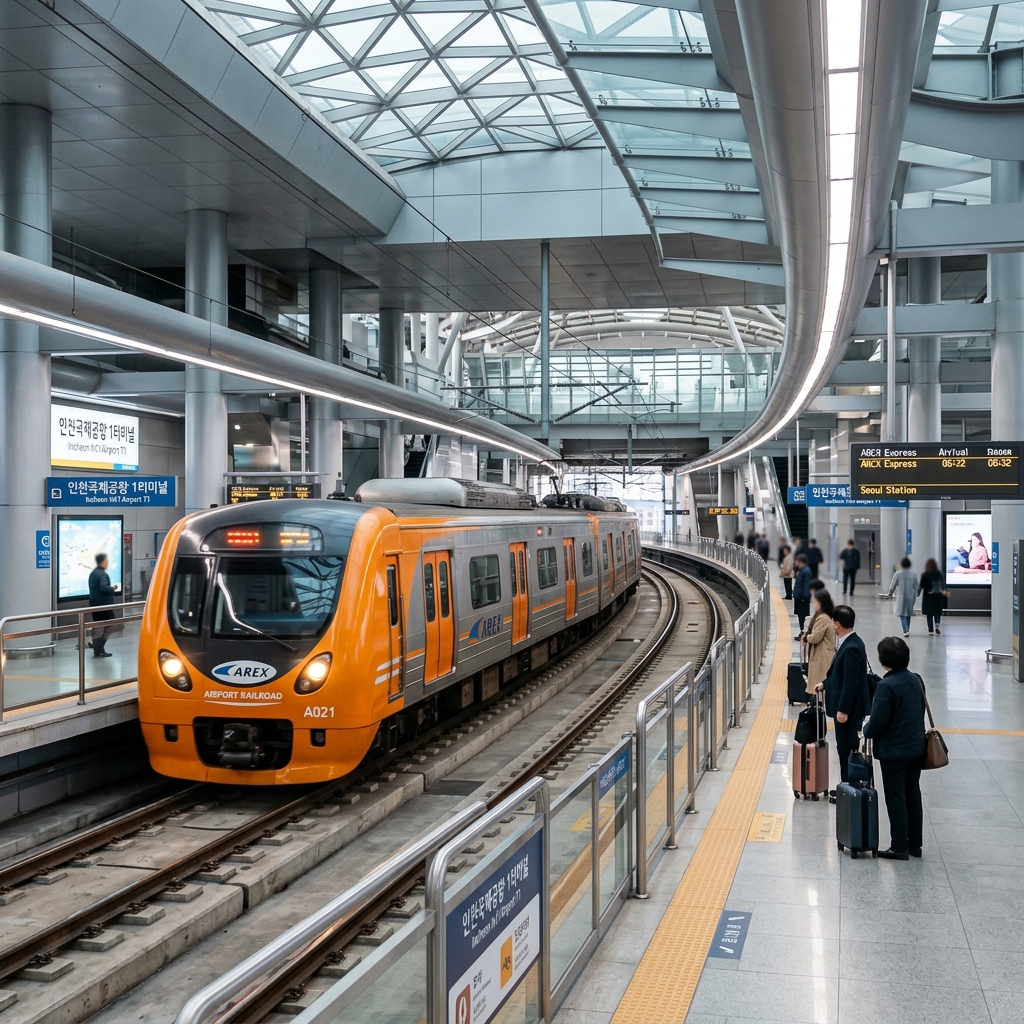
Incheon Airport to Seoul Station AREX Train: 2026 Foreigner’s Guide
The Airport Railroad Express (AREX) is the primary rail artery connecting Incheon International Airport (ICN) with central Seoul. It offers the most efficient and predictable method for traversing the 60-kilometer distance, bypassing the capital’s often-congested road traffic. The system operates two distinct services on the same tracks: the premium, non-stop Express Train and the commuter-style All-Stop Train. Understanding the specific functions, costs, and critical limitations of each is essential for a seamless arrival and departure experience. This guide provides an objective, step-by-step breakdown for international travelers navigating the Incheon Airport to Seoul Station AREX train.
Official AREX Booking & Ticket Reservation Step-by-Step
Securing a ticket for the AREX is a straightforward process, but the method differs significantly between the Express and All-Stop trains. The Express Train requires a dedicated ticket with a reserved seat, while the All-Stop Train operates on a standard tap-and-go transit card system.
Express Train Ticket Purchase
The Express Train offers reserved seating, ensuring a comfortable journey. Tickets can be purchased through several channels:
- Online/App Booking (Recommended): Third-party travel platforms like Klook or the official Korail “KORAIL TALK” app allow for advance booking. This is the most convenient option, as it secures your seat and provides a digital QR code, eliminating the need to queue at a ticket machine. Payment is typically made via international credit card.
- On-Site Vending Machines: Located in the Transportation Center at Incheon Airport (Terminals 1 & 2) and at Seoul Station, these multilingual machines accept cash and credit cards. Follow the on-screen prompts to select your departure time, number of passengers, and complete the payment. The machine will issue a paper ticket with a QR code and your assigned seat number.
- Customer Information Center: Staffed ticket counters are available for travelers who prefer in-person assistance or need to resolve ticketing issues. These are located near the vending machines.
Regardless of the purchase method, the Express Train ticket is a single-journey pass valid only for the selected train time. The fare is a flat rate, currently ₩11,000 for adults, but discounts are frequently available through online booking platforms or promotional campaigns.
All-Stop Train Fare Payment
The All-Stop Train functions as part of the Seoul Metropolitan Subway system. It does not have reserved seats, and tickets cannot be booked in advance. Payment is made using one of the following methods:
- Reloadable Transit Card (T-Money / Cashbee): This is the standard method used by residents and the most convenient for travelers. Simply tap the card on the reader at the blue entry gates and tap again upon exiting at your destination. The fare is automatically deducted. These cards can be purchased and reloaded at any convenience store or subway station vending machine. For a comprehensive overview of payment options, consult this Korea Travel Money Guide.
- WOWPASS Card: This all-in-one card for foreigners combines a prepaid debit card with T-Money transit functions, making it a popular choice. It can be used to tap in and out of the All-Stop train gates just like a standard T-Money card. Learn more about How to Use WOWPASS in Korea for seamless travel.
- Single-Journey Ticket: Purchase this from a vending machine at the station. You must select your exact destination. The ticket requires a ₩500 refundable deposit, which is included in the price. Upon arrival, you must use a “Deposit Refund Device” to return the plastic ticket card and retrieve your ₩500 coin. This method is cumbersome for multi-leg journeys and is not recommended for most travelers.
Express Train vs. All-Stop Commuter Train: Which Should You Choose?
The choice between the Express and All-Stop train depends entirely on a traveler’s priorities: speed and comfort versus cost and destination flexibility. The Express train is a dedicated airport-to-city service, while the All-Stop train is an integrated commuter line serving multiple neighborhoods and transfer points.
| Feature | AREX Express Train | AREX All-Stop Train |
|---|---|---|
| Travel Time (T2 → Seoul Station) | 51 minutes | ~66 minutes |
| Travel Time (T1 → Seoul Station) | 43 minutes | ~60 minutes |
| Stops | 0 (Non-stop) | 12 stops (including Gimpo Airport, Hongik Univ.) |
| Adult Fare (T1 → Seoul Station) | ₩11,000 (discounts often available) | ₩4,750 (with transit card) |
| Seating | Reserved, forward-facing seats (2×2 configuration) | Unreserved, subway-style bench seating |
| Onboard Amenities | Free Wi-Fi, restroom, overhead luggage racks, dedicated luggage storage areas, cabin crew service | Limited Wi-Fi, no restroom, overhead racks only |
| Ticketing Method | Separate QR code ticket (online or machine) | T-Money, Cashbee, WOWPASS, or single-journey ticket |
| Frequency | Every 30-40 minutes | Every 5-15 minutes |
| Platform Gates | Orange Gates | Blue Gates |
Analysis: When to Choose the Express Train
The Express Train is the superior option for travelers who prioritize comfort, predictability, and ease, especially after a long flight. The guaranteed seat and ample, dedicated luggage storage space remove significant travel stress. It is ideal for:
- First-time visitors to Seoul who want the simplest, most direct route.
- Travelers with multiple large suitcases or heavy bags.
- Families with young children or those with mobility concerns.
- Anyone wishing to use the Seoul Station City Airport Terminal services for their departure flight (this requires an Express Train ticket).
Analysis: When to Choose the All-Stop Train
The All-Stop Train is a practical and economical choice for budget-conscious travelers and those whose final destination is not near Seoul Station. Its integration into the broader transit network is its greatest strength. It is the better choice for:
- Travelers staying in areas like Hongdae (Hongik University Station) or near Gimpo Airport, as it provides a direct, one-seat ride.
- Budget travelers, as the fare is less than half the price of the Express Train.
- Experienced travelers who are comfortable navigating a busy commuter train with their luggage.
- Those who just missed an Express Train and do not want to wait 30-40 minutes for the next one.
For a deeper dive into navigating Seoul’s extensive subway and bus systems, refer to this complete Korea Public Transit Guide.
⚠️ Critical AREX Pitfalls & City Airport Terminal Rules
While the AREX system is highly efficient, several critical rules and potential pitfalls can cause significant problems for uninformed travelers. Adherence to these details is not optional and can determine the success of your journey.
Gate and Ticketing System Confusion
The most common error travelers make is attempting to use the wrong ticket at the wrong gate. The two train systems are physically separate at the turnstiles.
- Express Train Gates are ORANGE. They only accept the QR code issued for a specific reserved-seat ticket. A T-Money card or any other transit card will not work here. Tapping a T-Money card will result in an error, and you will be denied entry.
- All-Stop Train Gates are BLUE. These are standard subway gates and accept T-Money, WOWPASS, and other compatible transit cards. An Express Train QR code ticket will not work at these gates.
This separation is absolute. If you purchase an Express ticket, you must use the orange gates. If you plan to use a transit card, you must use the blue gates.
Seoul Station City Airport Terminal (CALT): Strict Regulations
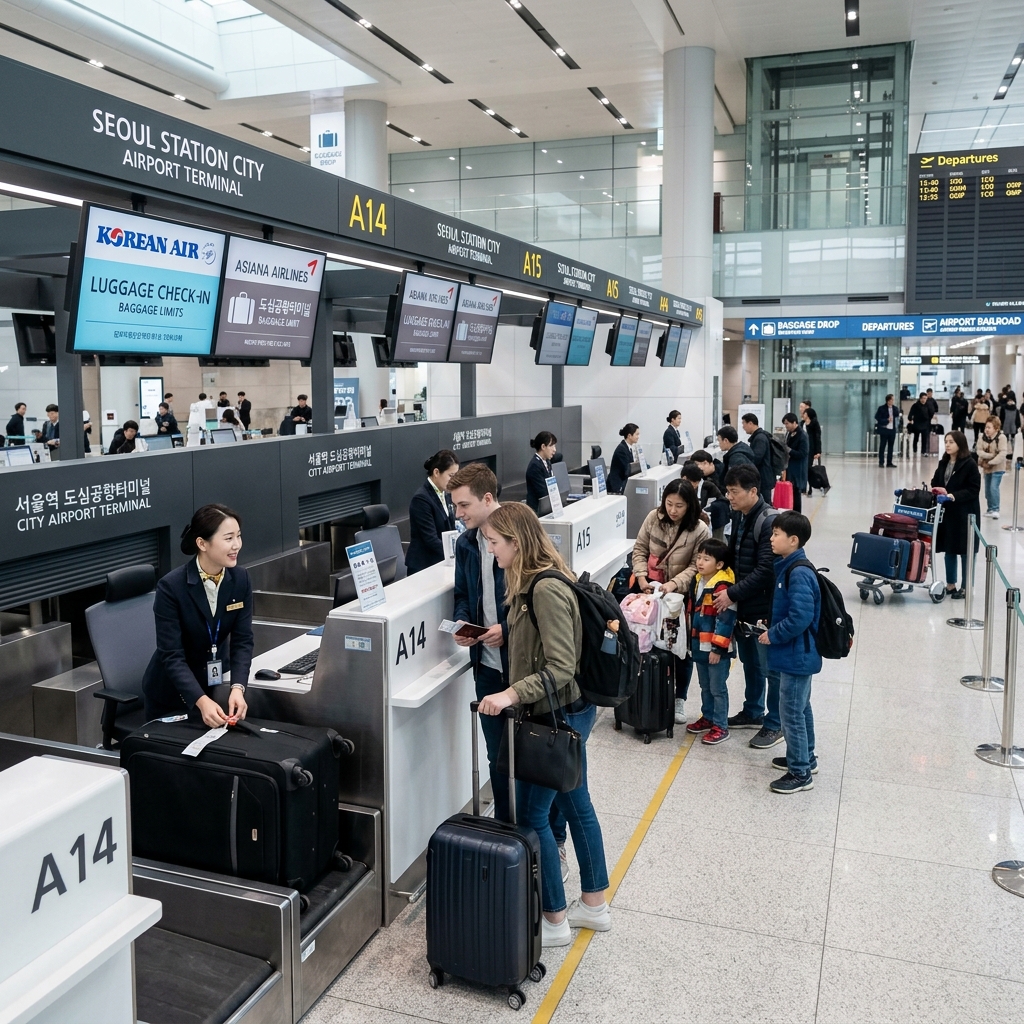
The City Airport Terminal at Seoul Station (B2 floor) allows travelers to check in for their flight, drop their luggage, and clear exit immigration before taking the AREX Express Train to the airport. While convenient, its use is governed by strict, non-negotiable rules.
- Eligibility Requirement: This service is available only to passengers holding a valid, same-day AREX Express Train ticket from Seoul Station to Incheon Airport. All-Stop train passengers cannot use this facility.
- Airline Participation is Limited: The service is restricted to a select group of airlines, primarily Korean national carriers. As of late 2024, this includes Korean Air, Asiana Airlines, Jeju Air, T’way Air, Air Seoul, and Air Busan. Many major international airlines and most low-cost carriers do not participate. Always verify the current list of participating airlines on the official AREX website before planning to use this service.
- Strict Time Cut-Off: Flight check-in and baggage drop must be completed no later than 3 hours prior to your international flight’s scheduled departure time (3 hours and 20 minutes for flights to the U.S. on specific carriers like Delta). There are no exceptions to this rule. If you arrive 2 hours and 59 minutes before your flight, you will be denied service.
- Operating Hours: The check-in counters and immigration office have limited hours, typically from 05:20 to 19:00. These hours are subject to change and do not accommodate late-night departures.
Failure to meet any one of these conditions will require you to carry your luggage to the airport and check in through the standard process at the main airport counters.
⚠️ Crucial Train Transfer Hacks & Luggage Storage Rules
Transfers at Seoul Station: Seoul Station is a massive, multi-level transit hub. The AREX platforms are located deep underground. Transferring to Subway Line 1 or Line 4 can involve a walk of 10-15 minutes, including multiple long escalators and crowded passageways. Travelers with heavy luggage, strollers, or mobility issues should allocate significant extra time for this transfer. The station is also the main terminus for high-speed KTX trains; if you are connecting to another city, learn How to Book KTX Tickets as a Foreigner in advance to streamline your journey.
Luggage Storage & Logistics: While the Express Train has ample luggage space, the All-Stop Train’s overhead racks are insufficient for large suitcases. During peak commuter hours (07:00-09:00 and 17:00-19:00), the train can become extremely crowded, making it difficult to manage bulky items. If you must take the All-Stop with large bags, travel during off-peak hours. For storage at Seoul Station, automated lockers are available but have size limitations. For oversized luggage, use the staffed Safex baggage storage center.
Terminal 1 vs. Terminal 2: Incheon Airport has two separate terminals connected by the AREX line. Terminal 2, which primarily serves Korean Air and SkyTeam alliance partners, is the final stop. Terminal 1 serves Asiana Airlines, Star Alliance partners, and most foreign carriers. Confirm your departure/arrival terminal before your journey, as the train stops at T1 first when heading into Seoul, and T2 is an additional 6-minute ride. Upon arrival, one of the first tasks is securing connectivity; this detailed Incheon Airport SIM Card & eSIM Guide breaks down the best options available directly in the arrivals hall.
Written by Min-Woo Park (Senior Travel Editor)
Min-Woo Park is a Senior Travel Editor for K-Travel Insider, specializing in South Korean public transportation systems, digital payment logistics, and foreigner travel guides. He covers official Korail regulations, transit passes, and local payment technologies.
Home |
About Us |
Contact Us |
Privacy Policy |
Terms of Service |
Disclaimer
Copyright © 2026 K-Travel Insider (koreanvalueinvestor.com). All rights reserved.