The Industry Everyone Wrote Off
In the first quarter of 2026, the outlook for Korean battery stocks ESS and EV divisions looked grim as the three major battery makers posted simultaneous quarterly losses for the first time in history. LG Energy Solution lost 207.8 billion KRW, while both Samsung SDI and SK On also posted losses. When the U.S. ended electric vehicle (EV) subsidies late last year, roughly $45 billion in American factory investments suddenly became a heavy burden.
Analysts started writing obituaries for major Korean brands. They were wrong. The opposite story is now unfolding—and most global investors haven’t noticed the massive turnaround in Korean battery stocks ESS divisions yet.
Why AI Data Centers Need Korean Battery Stocks ESS Solutions
AI data centers are power-hungry monsters. They run 24/7, and AI computing workloads cause electricity demand to swing violently from 30% to 100% in seconds. If the power grid cannot absorb those swings, the entire data center crashes.
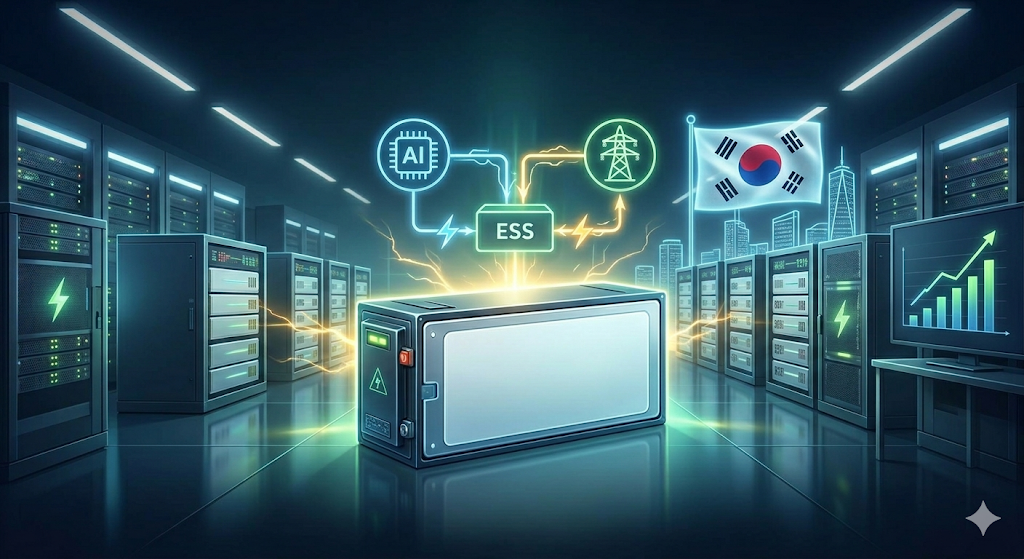
The ultimate solution is the ESS (Energy Storage System). These massive battery setups store surplus power and discharge it when demand spikes, acting as a crucial shield for the grid. This is exactly where the value of Korean battery stocks ESS infrastructure comes into play.
The market numbers tell the story. The AI data center ESS market is projected to grow from $1.2 billion in 2025 to $4–6 billion by 2030—a compound annual growth rate of 28–38%. The U.S. AI sector alone will need 50 gigawatts of new power capacity by 2028—roughly twice the peak electricity demand of New York City.
The Real Catalyst: America Locked China Out
Here’s the part almost no English-language coverage explains regarding Korean battery stocks ESS growth.
In 2025, the U.S. passed the OBBBA legislation, and starting in 2026 it enforces “FEOC” (Foreign Entity of Concern) rules. The core principle is simple: companies linked to China cannot claim the lucrative ESS investment tax credit (48E).
The problem? China currently dominates the global battery supply chain—controlling most of the world’s processing of battery-grade lithium, cobalt, and graphite. The consequences of this policy are dramatic:
- FEOC rules have raised U.S. battery storage prices by 30–50%.
- Projects using Chinese components get a 0% tax credit, while non-Chinese components enjoy 30–40%.
- The market has split into two distinct tiers.
Remove China from the equation, and the major suppliers left standing in the U.S. market are essentially the three Korean companies. The American government has, through policy, handed Korean battery makers a protected market. The three Korean firms are expected to have over 50 GWh of FEOC-compliant ESS production capacity by the end of 2026—potentially enough to meet domestic U.S. demand.
Korean Battery Stocks ESS Strategies: Same Crisis, Different Approaches
The three major players are responding very differently. As a GARP (Growth at a Reasonable Price) investor, analyzing these differences matters enormously.
Samsung SDI — The Market Favorite
Samsung SDI’s stock has dramatically outperformed, with returns roughly six times those of LG Energy Solution. Some analysts have floated price targets implying a major re-rating for this prominent Korean battery stocks ESS contender.
Its strategy focuses on high-end products—UPS and battery backup units for data centers—and it’s reportedly in talks with Tesla for a second ESS order. Critically, Samsung SDI plans to mass-produce solid-state batteries in late 2027, two years ahead of competitors targeting 2029.
The Caution: Samsung SDI is still projected to post an operating loss in 2026, and some brokerages have lowered price targets, arguing the stock is expensive relative to current earnings.
LG Energy Solution — The Order Book Giant
LG Energy Solution’s backlog is staggering. As of late April 2026, it had secured around 440 GWh of ESS orders in North America alone. It’s already mass-producing ESS cells at its Michigan plant and actively converting former EV production lines to ESS use.
The Caution: LG ES is still unprofitable, and ESS generally carries lower profit margins than EV batteries.
SK On — The Laggard
SK On is furthest behind in the Korean battery stocks ESS race. Its debt-to-equity ratio sits at 200%—far higher than LG (125%) or Samsung SDI (80%)—creating severe financial strain. It’s currently restructuring by unwinding Chinese joint ventures and selling non-core assets. Its turnaround will likely come last among the three.
What Investors Should Watch in the Korean Battery Stocks ESS Market
Most global investors still blindly see Korean battery makers as mere “EV companies.” That’s why they abandoned them during the EV slowdown.
But the structural reality is entirely different. Korean battery makers are being reborn as core suppliers to U.S. AI infrastructure—inside a market the American government has deliberately protected by excluding Chinese competitors.
The risks, of course, remain real:
- ESS margins are currently thinner than EV batteries.
- FEOC rules still have unfinalized regulatory details.
- All three companies have pushed their return-to-profit timelines to the second half of 2026.
My GARP view: Short-term earnings are still in the red. However, the structural shift created by massive order backlogs and a protected policy environment is undeniable. The key is to confirm whether the return to profitability actually happens in H2 2026. That precise moment will be the ultimate trigger for a major stock re-rating.